Thursday, August 25, 2022


Monday, August 22, 2022
Warp And Weft by Laura Veirs.

Today I thought I would tell you about a CD that I bought last week. It is called Warp and Weft by Laura Veirs. Laura is a singer-songwriter based in Portland, Oregon USA and this is her ninth album released in 2013. One of the reasons I bought the album is because I saw Laura perform at Glastonbury in June, but I wasn’t paying attention. Her set only lasted forty minutes and I was either talking to people or going to the bar. However, I did like what I did hear and took a couple of photos, so hopefully this review will make up for my inattention. I read that this was her most successful album when it was released and was given very favourable reviews.

The album title comes from the names of the two components of turning thread into fabric, which might be symbolic of weaving the music into her songs. The album is produced by her then husband Tucker Martine and features the likes of Neko Case, K.D.Lang and members of The Decemberists. Laura was expecting her second child while writing and recording this work, so I think a lot of songs reflected her fears of what sort of a world children would be growing up in. The opening track Sun Song displays her talent as a guitar player and singer. Neko Case sings harmony vocals. I believe this catchy song was released as a single. (I have shared an excellent video below).
 |
| Laura Veirs, Glastonbury. |
America is a much darker song, concerned with the obsession with guns. Finster is a great song about the Baptist minister and folk artist Howard Finster who created the sculpture park known as Paradise Garden. He even designed album sleeves for REM and Talking Heads. I’m not sure who inspired Dorothy Of The Island, but it has some quite dark lyrics and a chorus about motherless children. Shape Shifter reminds me of the starlings that I can see right now as I look through the kitchen window. There is a great instrumental passage in this song featuring violins, viola and cello. There are two short and sweet instrumentals on the album Ghosts of Louisville, and Ikaria, which I assume was inspired by a visit to the Aegean Sea.

Say Darlin’ Say is adapted from a traditional lullaby which was first recorded by The Sweet Brothers in 1928. That Alice is a tribute to Alice Coltrane who as you know was the wife of John Coltrane who later became a swamini and founded her own ashram. The sound isn’t what you would expect though. It is more rock than jazz with swirling electric guitars. The most moving song on the album for me is Sadako Folding Cranes which tells the story of Sadako Sasaki who lived near the Misasa Bridge in Hiroshima. She was two years old when she was blown through a window when the atom bomb exploded. She died of radiation poisoning at the age of twelve. Before she died, she reached her target of folding 1,000 paper cranes from origami.
 |
| Sadako Sasaki. |
The CD actually contains a colourful sheet of paper which you can fold into a paper crane by following Laura’s tutorial on her website. Sadako is remembered every year on the anniversary of Hiroshima. Watching the news these days with the war in Ukraine is a reminder of the danger the world still faces. Ten Bridges is another song concerned with the worry of the future. I think the ten bridges referred to must be the number of bridges over the Columbia river in Portland. The album ends on an optimistic note with White Cherry which has an almost Avant-Garde jazz sound which I really like. I’m glad I bought this album and got acquainted with the music of Laura Veirs. I don’t know if her long time fans rate it as one of her best albums, but I enjoyed it very much indeed and I’ll certainly listen to more of her music in the future.

Thursday, August 18, 2022
Song of Granite.

I watched a wonderful Irish film yesterday called Song of Granite. It is a film that I have been meaning to see ever since it was released in 2017, but it was only yesterday after a Facebook friend reminded me of it that I looked online and found you could rent it on the BFI website for £3.50, which is a bargain. The film is directed by Pat Collins and tells the story of Joe Heaney who was a singer from Connemara in the West of Ireland who sang in the Sean-Nos tradition. Sean-Nos simply means ‘in the old way’ and is unaccompanied and usually sung in Irish. The film is in monochrome which I think perfectly suits the melancholy atmosphere of the story. Joe Heaney was born in Carna, County Galway in 1919 and began learning songs from the age of five, but he was so shy that he didn’t sing in public until the age of twenty. He is portrayed at different stages of his life by three actors, Colm Seoighe, Mícheál Ó Confhaola, and Macdara Ó Fátharta.

Colm Seoighe who plays Joe as a child is a very promising young actor, and a talented musician, singer, and songwriter. In the past whenever I wrote a review on this blog page of a Christy Moore album or concert Colm would correct any mistakes I made. He seems to be an expert on Christy’s music. I think we will hear a lot more about him in the future. The opening scenes of the film show the young barefoot Joe looking for birds’ nests in the long grass, sitting around a turf fire listening to folk stories being told, fishing for lobsters, and planting potatoes with his dad. At school after learning the catechism he is made to sing for the class. In one memorable scene a musicologist visits the village and records Joe’s father singing into a primitive recording machine while Joe watches intently, although he is too shy to sing himself. The cinematography of this film is very artistic, particularly of the landscape scenes. The sight of empty wild birds egg shells and a car in the distance tells us that Joe is intending to fly from the nest.
 |
| Joe Heaney. |
As well as Colm, Mícheál Ó Confhaola is also an excellent singer. Joe moves to Glasgow and then London, working on building sites. He was a restless spirit, always with his eye on the horizon. He gains a reputation singing in pubs and folk clubs. One of the highlights of the film is a pub scene where Lisa O’Neill sings The Galway Shawl. I wonder if she was meant to represent Margaret Barry. For me it was also great to see two people I recognised from performances at Glastonbury, Damian Dempsey singing The Rocky Road To Dublin, and also Radie Peat from Lankum. I also spotted Cathal Hayden who I have seen playing with Christy Moore. Joe sings a long Sean-nos song which I’m pleased the director didn’t edit, but I wish sub-titles had been provided so that I could understand the song. Also, it is never explained why he walked out on his wife and children. You get the feeling that it was something he lived to regret.

In the mid-1960s Joe is invited to perform at the famous Newport Folk Festival and he decides to move to New York where he works as a hotel doorman for twenty years. He is befriended by the likes of the Clancy Brothers who help him become known on the folk music scene. Although the story is dramatized, it also contains interesting archive newsreel footage and the real Joe Heaney singing. Towards the end of the film there is a scene where Joe touches the stone facing of a building in New York. It is very poignant because you know he is homesick for the dry stone walls of home and wants to return. This is common with Irish people who emigrate. They may leave Ireland physically, but they never leave spiritually. As Van Morrison once said, ‘The world is so cold, don't care nothing 'bout your soul, you share with your own ones’.

There is one very moving imaginary scene where the old Joe meets the young Joe, and they talk about life and poetry. Joe died in Seattle USA in 1984 aged 62. He had become an artist in residence at Washington University where there is an ethno-musicology archive in his memory. This film struck a chord with me because my family came from the west of Ireland, but I think if you like music, beautiful scenery, and a great story then I highly recommend that you watch Song of Granite. I have shared a trailer below if you want to see it.

Friday, August 05, 2022
Listening To Little Walter.

A new CD arrived here a couple of days ago called The Best Of Little Walter. It was Little Walter’s first album and was originally released in 1958, a collection of ten tracks that were hits on the American R & B charts in the 1950s plus two B-Sides. Rolling Stone magazine placed this record at number 198 on its list of the 500 greatest albums ever made. I think Rolling Stone might have placed it that high because of a guilty conscience, due to the fact that most white Americans ignored blues music until it was sold back to them by British blues bands in the 1960s. I have played it four times now and it grows on me with every listen.

As is often the case with me discovering new music, it was Van Morrison who pointed me in the direction of Little Walter. I remember many years ago reading an interview with Van where he recounted a story about meeting Little Walter in London in 1964. Van’s band Them had just arrived in London, and Walter was on his first trip to Europe. They were all staying at the Aaland Hotel in London. In return for Van buying Walter some Chinese food he taught Van some of his harmonica techniques. I was reminded of all this five years ago when Van recorded Walter’s song Mean Old World on his Roll With The Punches album. If (like me until a few days ago) you don’t know a lot about Little Walter, I’ll just tell you a little about him that I learned from Wikipedia.
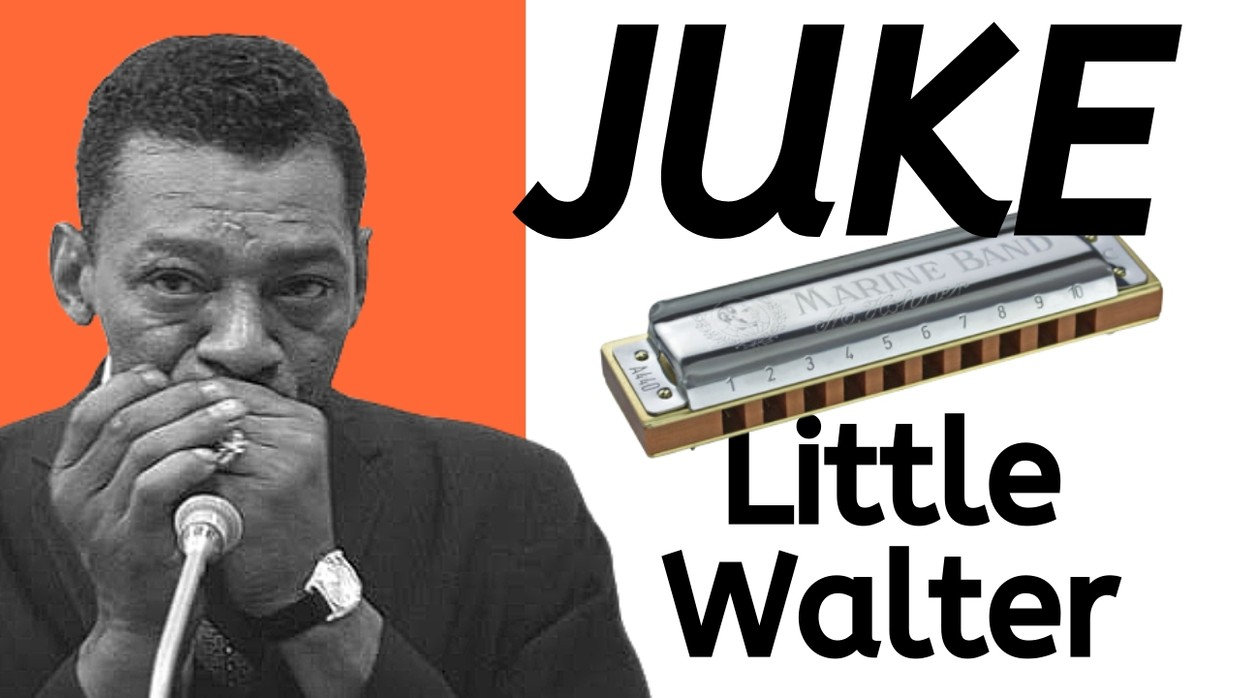
He was born Marion Walter Jacobs on May 1, 1930, in Louisiana. He was a blues musician, singer, and songwriter, whose revolutionary approach to the harmonica had a strong impact on succeeding generations. His virtuosity and musical innovations fundamentally altered many listeners' expectations of what was possible on blues harmonica. He was inducted into The Rock and Roll Hall of Fame in 2008, the first and, to date, only artist to be inducted specifically as a harmonica player. He arrived in Chicago in 1946 and joined Muddy Waters band in 1948. He left Muddy Waters in 1952 for his own career, but still appeared on most Muddy Waters records during the 1950s.

His found fame recording as a solo artist with the instrumental Juke in 1952 which reached number 1 on the R & B charts. Walter was an alcoholic with a nasty temper which often led to fights and minor run ins with the law. In February 1968 he was involved in a fight while playing at a night club in Chicago and died the following morning. He was buried in an unmarked grave, until some fans had a marker designed and installed in 1991.
So, to the album. The black and white photo on the cover
shows Walter playing a Hohner 64 chromatic harmonica. The first track My
Babe was written by Willie Dixon who also played bass and produced
this album. I first heard of Willie Dixon in 1964 as the writer of Little Red
Rooster by The Stones. Sad Hours is a slow instrumental with guitar and
wailing harmonica. You’re So Fine is an upbeat R & B number typical
of the music that inspired young bands of the 60s. Last Night is soulful
by comparison. The great American writer and social commentator Studs Terkel
said, ‘Perhaps, the essence of Little Walter comes through most clearly
in the slow blues, “Last Night.” There is a moaning and a crying and a shouting
here that makes it plain, this man’s harp is his voice – much like Armstrong’s
trumpet speaks for him . . . Little Walter and his harmonica are of one piece’.
Blues With A Feeling was originally written by Rabon Tarrant, but Walter rewrote it and claimed it as his own. It is now regarded as a blues standard which has inspired many musicians to play the harmonica. Can’t Hold Out Much Longer features Muddy Waters on guitar. Juke is a very catchy and probably Walter’s signature tune I would imagine. I wonder if this is the tune he taught Van to play? Mean Old World which I mentioned earlier is next, and I have shared a video below of Walter playing this song live with Hound Dog Taylor if you want to see it. It was originally recorded by T Bone Walker, another song that Walter took for himself. Off The Wall is another great instrumental displaying Walter’s virtuosity. You Better Watch Yourself sounds quite threatening, which might hint at Walter’s dark side. One of my favourite tracks is Blue Lights, a very atmospheric instrumental. The album ends with the upbeat Tell Me Mama. I have enjoyed getting into this album the last two days. I’m not an expert on blues music at all, so it has been quite educational for me listening to and learning about the great Little Walter.

Blues With A Feeling was originally written by Rabon Tarrant, but Walter rewrote it and claimed it as his own. It is now regarded as a blues standard which has inspired many musicians to play the harmonica. Can’t Hold Out Much Longer features Muddy Waters on guitar. Juke is a very catchy and probably Walter’s signature tune I would imagine. I wonder if this is the tune he taught Van to play? Mean Old World which I mentioned earlier is next, and I have shared a video below of Walter playing this song live with Hound Dog Taylor if you want to see it. It was originally recorded by T Bone Walker, another song that Walter took for himself. Off The Wall is another great instrumental displaying Walter’s virtuosity. You Better Watch Yourself sounds quite threatening, which might hint at Walter’s dark side. One of my favourite tracks is Blue Lights, a very atmospheric instrumental. The album ends with the upbeat Tell Me Mama. I have enjoyed getting into this album the last two days. I’m not an expert on blues music at all, so it has been quite educational for me listening to and learning about the great Little Walter.
 |
| Muddy Waters, Lttle Walter & Bo Diddly. |
Subscribe to:
Posts (Atom)
Popular Posts
-
 It is now Thursday afternoon, and I’m Remembering Now the events of the past two nights in the beautiful city of Bath with Van Morrison , h...
-
 The story of Vashti Bunyan must be one of the most interesting in the history of music. I had never heard of her until a few weeks ago when...
-
 A couple of years ago I wrote a piece on here about the influence of Hank Williams on Van Morrison . Tonight, I thought I’d write about ano...
-
 Friday: It was with a feeling of trepidation that I set off on Friday afternoon for my local record shop in Warminster. I had read some scat...
-
 Van Morrison will be celebrating his 78 th birthday in a few days’ time, but the Celtic soul brother is showing no sign of slowing down. Va...
-
 Patrick Kavanagh died on this day November 30 th in 1967. He was one of the finest Irish poets and a novelist. Arguably second only to W.B...
-
 If you have read my blog page for a while you probably know that I am a big fan of The Unthanks . Recently I saw their 2009 album Here’s The...
-
 It is another dark, windy and rainy day here. I won’t be going out today. I am listening to a CD called Folksongs & Ballads by Tia Blake...