Saturday, March 02, 2024

Blues Run The Game: The Story Of Jackson C. Frank.

 Jackson C. Frank died 25 years ago today on March 3rd 1999. He was a great and very underrated singer-songwriter, so I thought I'd dust off this piece I wrote about him several years ago............
I am indebted to an internet friend  for bringing this influential singer-songwriter to my attention because I had never heard of him before. I think he must have read some of my previous stories of musicians who had faded into obscurity and are only now being re-discovered and thought I might be interested in listening to Jackson C. Frank.
I am really pleased I bought this album because some of the songs are as good as any I have heard in the folk genre. The story of Jackson C. Frank is also one of the saddest I have ever read about any musician.  Although he released only one official album in his lifetime he was very influential on the likes of Paul Simon, Sandy Denny, Al Stewart, Dave Cousins, John Renbourn, Bert Jansch, Nick Drake and Roy Harper. It was only a series of misfortunes that stopped him from being remembered as one of the great folk singers.

Tragedy struck early in his life at the age of eleven. He was attending elementary school in a suburb of New York when a heating furnace exploded which caused a fire that killed fifteen of his classmates including his first girlfriend Marlene Du Pont. He later wrote a song about Marlene which is on the album. Jackson survived the fire but had burns to 50% of his body. It was during the long recovery process that he learned to play the guitar and began writing songs. In 1965 while studying journalism at Gettysburg College he received $100,000 in  insurance  compensation for his injuries. He dropped out of college and sailed to England to try his luck on the folk scene. It was on that voyage that he wrote the song Blues Run The Game.
Jackson soon made a name for himself in the Folk Clubs of London and made friends with Paul Simon and Art Garfunkel. Paul Simon was so impressed with his talent that he offered to produce an album. The whole album was recorded in only three hours. Before long Jackson became quite famous in Britain. He persuaded his girlfriend at the time Sandy Denny to give up her job as a nurse and concentrate on singing. We should be grateful to him for that act alone because Sandy became arguably the greatest British female singer of all. Sandy recorded three of Jackson's songs for her first solo album in her pre-Fairport Convention days.
The following year though things began to go wrong. Firstly, he developed writers block and was never happy with the songs he came up with, and also he began to suffer with really bad stage fright. It was the beginning of the mental illness that was to haunt him for years to come. His money ran out. In only two years he had managed to blow the lot. He returned to the states and moved to Woodstock which was a haven for many artistic people at that time. He landed a job as a journalist and married a former fashion model. New songs were written and he was just about to relaunch his music career when disaster struck once again. His infant son died of cystic fibrosis and the marriage fell apart. These events drove him over the edge and he descended into an abyss of depression, finally ending up homeless on the streets of New York. Things got even worse when he was shot by a gang of street toughs which left him blinded in the left eye. For twenty years he was virtually forgotten and had lost all touch with family and friends.
A guardian angel then appeared by the name of Jim Abbott who was an American folk music fan who managed to track down the long lost singer. Jim took Jackson to see sympathetic doctors and his condition immediately began to improve. He had been mis-diagnosed as paranoid-schizophrenic, but what he was actually suffering from was post-traumatic stress disorder caused by the terrible fire of his childhood. As soon as was taken off the anti-depressants and given trauma therapy instead there was a remarkable recovery. His music career was revived and his work was issued for the first time on CD with previously unreleased material.
Sadly, in 1999 Jackson C. Frank caught pneumonia and died of a cardiac arrest at the age of only 56. He has left a small but great legacy of music, and his influence continues to grow. His songs have been covered by Simon & Garfunkel, Counting Crows, Laura Marling, Robin Pecknold of the Fleet Foxes, Marianne Faithful and many others. His songs have also appeared in movie soundtracks such as Daft Punk's Electroma. Only today I discovered there is a book about him by Jim Abbott and a documentary film is a work in progress at the moment. His legend is finally beginning to grow.
The album I am listening to at this very moment contains all the songs from his eponymous album of 1965 plus five unreleased songs from 1975. I must say I love it, you can see the influence he had on Paul Simon on songs like Dialogue. To hear these haunting songs live in a folk club back in 65 must have been an amazing experience. The five songs from 1975 make me think what a shame it is that he left such a small body of work. One song called Madonna Of Swans I find particularly powerful.
Marlene, the song about his girlfriend who perished in the fire is also very moving. To give you a taste of the album I have put a video of Blues Run The Game below which I urge you to listen to. 

Wednesday, February 21, 2024

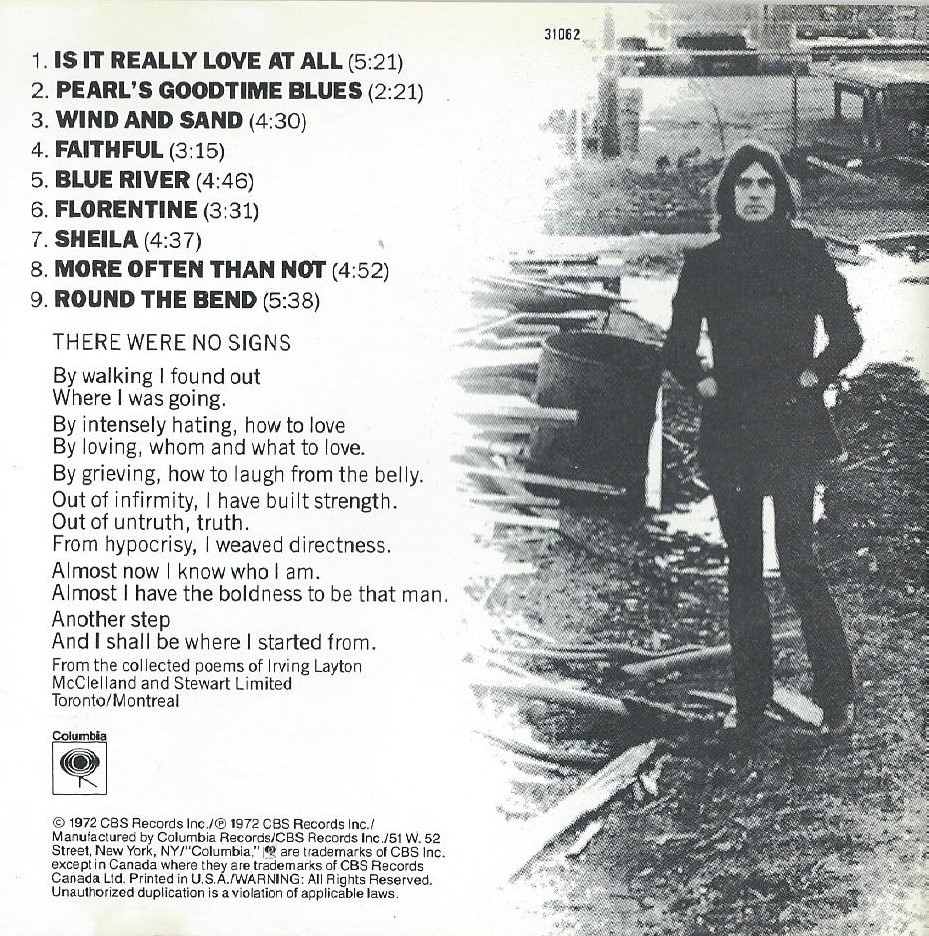
Blue River by Eric Andersen.

It was a lovely day yesterday, almost like Spring had arrived. I even managed to get a bit of gardening done. However, today is another story, back to grey skies and rain, so I thought I’d pass the time by telling you about an album I have been listening to recently. It is called Blue River by Eric Andersen, recorded in Nashville in 1972. I am amazed that I hadn’t discovered this music decades before now because this album is excellent. I first became aware of Eric a few months ago when I bought a 2CD compilation called Greenwich Village In The 60s. It contained a song by Eric called Close The Door Gently When You Go which I thought was great. Then more recently on youtube I heard another song I loved where Eric sang with Judy Collins called Thirsty Boots (See video below). This prompted me to read more about him. I learned that his most commercially successful and critically acclaimed album was Blue River. One reviewer compared it to Astral Weeks by Van Morrison. “That will do for me”, I thought, and bought a copy on eBay.

I am listening to the opening track Is It Really Love At All at this very moment. It is wonderful, but I don’t know where that reviewer got the Van idea from. The singer I was most immediately reminded of on this album is James Taylor. The production by Norbert Putnam throughout all these songs is first rate. This opening track has a very tasteful string and woodwind arrangement. Eric’s wife of the time Debbie Green sounds perfect on backing vocals. Debbie contributes a lot to several tracks on guitar, piano and vocals. I have read that Debbie taught Joan Baez how to play guitar and Joan imitated her voice and stole her repertoire. I don’t know how true that is though. Pearl’s Goodtime Blues is a tribute to Eric’s friend Janis Joplin. This track sounds Like The Band and even has ‘Rag, Mama, Rag’ in the lyrics. I see Kenny Buttrey who I know from his playing with Bob Dylan and Neil Young plays drums on this track and several others. 

Wind And Sand is much simpler with just Eric on piano and Norbert on bass. Simple, but very moving and effective, a melancholy meditation on the passage of time. Faithful is another wistful emotional song, but immediately accessible with a catchy chorus, quite country influenced. This song should have been a big hit. The title track Blue River is next, with Eric on piano. This has an epic gospel infused sound with the great Joni Mitchell on backing vocals. I’m sure Joni must have been influenced by this song when she was recording her album Blue (or vice-versa, maybe Eric got ideas from Joni). Florentine is another splendid track with Kenny’s percussion driving the song along, harpsichord courtesy of Gleen Spreen, guitar by Grady Martin

Sheila is the darkest song for me on this album. A wistful world-weary pleading song, possibly about the effects of heroin addiction. The haunting electric guitar adds to the feeling of desolation. It isn’t the kind of song associated with Nashville; it reminds me more of the denizens of New York’s Chelsea Hotel. More Often Than Not is the only track not written by Eric, David Wiffen an English-Canadian folk singer-songwriter wrote this one. It is more upbeat than Sheila, but the subject matter is again quite dark, a reflection on loneliness and betrayal. I see Rick Schlosser plays drums here. He played on three Van Morrison albums in this era of the early 70s. 

The final track is Round The Bend which is another introspective song of being alone, ‘stumbling hopelessly, yes I knew that man well, for that prisoner he was me’. This song has a full gospel treatment with The Jordanaires plus backing singers such as Florence Warner and Millie Kirkham. Eric plays piano on this truly epic wonderful song. It’s nice to see in the sleeve notes that Eric thanks Patti Smith for her help and friendship. Patti was still quite unknown in 1972. 

You will be pleased to know that Eric is 81 now and still singing and performing. The early 1970s were a golden era for great singer-songwriters like Bob Dylan, Neil Young, Joni Mitchell, Carole King, Leonard Cohen, Cat Stevens, James Taylor, Jackson Browne, you could go on and on, there were so many, so that might be why I overlooked Eric, but I think this album stands up very well indeed alongside all those people, so I am very pleased I finally discovered Eric Andersen, even if it took me over fifty years. Cheers.

JUDY COLLINS & ERIC ANDERSEN - "Thirsty Boots" 2002

Sunday, February 11, 2024

Down By Avalon. (Part 2, In The Church Of St John)

I was up and about early on Thursday after one of the best sleeps I had for ages., and after a leisurely breakfast headed into town for another day of exploring Glastonbury. Nowhere was open yet and it was drizzling rain, so I sheltered in the porch way of St John’s church. This is another place associated with Van Morrison because it is mentioned in his epic song Summertime In England, ‘Would you meet me in the country, In the summertime in England, Would you meet me? In the Church of St. John, Down by Avalon’

There is a thorn tree in the grounds grown from the Glastonbury Thorn.  According to legend, Joseph of Arimathea visited Glastonbury with the Holy Grail and thrust his staff into Wearyall Hill, which then grew into the original thorn tree. Every Christmas a blossom from this tree is taken to the royal family to decorate their Christmas table. Suddenly, on the stroke of 9.00 the door behind me opened, and the verger came out. I thought it was only polite to have a look inside. There is a beautiful stained-glass window to be admired in the 15th century church, although it is believed that St Dunstan built a wooden church here in the 10th century. 

When I emerged from the church it was still raining, so I thought I had better go back to the digs for my raincoat. I did that, and although it threatened to, it never rained again all day. When I restarted my walk, I decided to head up Bove Town (derived from Above Town) towards the countryside. Eckhart Tolle used to live on this street before he became famous and used to walk up here to the Tor every day. As I walked along, I wondered which house he lived in. Winston Churchill’s granddaughter Arabella lived here as well. She was one of the driving forces behind Glastonbury Festival in its early days. I wonder if she and Eckhart knew each other. As I reached the open countryside there is a steep embankment on either side of the road. A landslip in the past had exposed the roots of trees growing beside the road. I was amazed to see that the roots of two trees had entwined with each other. It was almost as if they were supporting each other in order to stand up. It makes you realise the wonders of nature. 

I wandered along the little lanes following a circular route until I arrived at the Tor again, on the opposite side to yesterday.  I was tempted to climb it again, but in view of the threat of rain changed my mind and headed down the lane towards town. Near the White Spring I spotted this man placing bird food on the top of a wall. There were about 30 or 40 little birds of several species gathered along the wall gobbling up the seeds voraciously. The man told me that he had fed them every day for about three years, the birds had got used to him and were quite tame. Quite wonderful.

I walked down Magdelene Street past an incredible mural painted on the side of a house. There are murals all over the town which all add to the magic of this place. Then I discovered St Margaret’s Chapel & The Magdelene Almshouses which I’d never seen before. The almshouses were built in the 13th century to accommodate the poor men of the town. What immediately struck me was how tiny the doorways were. People were a lot shorter in medieval times than we are today. The chapel built in 1250 is dedicated to St Margaret who was a Queen of Scotland and dedicated her life to tending the sick and was made a saint by Pope Innocent 1V. 

After that little interlude I crossed the road and entered the Abbey grounds. I have been here many times before, often for memorable concerts, but I never tire of visiting this historic site which is steeped in myth and legend. The place is undergoing a major restoration and development at the moment which will make it even more spectacular in future years. I was especially pleased to see that the grassy areas were carpeted with hosts of snowdrops, crocuses and yellow ancorites. A reminder that Spring cannot be too far away. 

I went back to the Market Tavern for dinner where the barman told me that they were having a pub quiz and open mike music night later. I arrived for the quiz at 8.00, but was disappointed to find there was no quizmaster, you had to download an app to take part, and answer the questions on your phone. The answers came up on a big screen which told you who answered first. It all seemed too impersonal to me, so I didn’t bother taking part. I enjoyed the live music though. It was all local musicians, some of whom were very talented, singing songs by the likes of Bob Dylan, Johnny Cash and John Prine. I ended up drinking about five pints of cider which is a lot for me these days. It was a fun end to a most enjoyable day. 

I thought I would feel a bit rough the next morning due to the cider, but I felt great. After breakfast I went for a last walk around town and had a good browse in the bookshops. I ended up buying three books, After The Ecstasy, The Laundry by Jack Kornfield who is a Buddhist writer and teacher I have long admired, Echoes Of Memory, poems by John O’Donohue and Daily Wisdom, 365 Buddhist Inspirations. I might tell you all about these books in due course. Finally at 11.30 Michelle drove me back to Castle Cary which was the end of my too brief visit to mystical Glastonbury. I hope that I return before too long. THE END.


Down By Avalon (Part 1, Enlightenment)


As my reward for doing Dry January, I thought I would treat myself to a couple of days away in my favourite small town in Somerset. Although Glastonbury is only 30 miles away it is quite awkward to get to if you don’t have your own transport. Luckily for me the B & B landlady Michelle kindly offered to meet me at Castle Cary railway station and drive me to Glastonbury. It was nice to see her again, and stay at her cosy little B & B. The weather forecast wasn’t great for the next few days, so I was keen to see as much as possible before the rain arrived.

As soon as I had unpacked my stuff, I headed out again to explore the town and revisit my favourite places. My first port of call was The Chalice Well and gardens. I was pleased to see that some flowers were already blooming in early February. The well is also known as the Red Spring because of the high iron content of the water which leaves a red deposit on everything it touches. I drank a few sips of the water at the Lion’s Head drinking fountain because it is said to have healing properties.

There is a meditation space at the Chalice Well called ‘The Upper Room’ which is exclusively for silent contemplation. The lyrics of Van Morrison’s song Avalon Of The Heart came into my head, ‘In the upper room. There the cup does stand, In the upper room, Down by Avalon’. Van’s songs often enter my consciousness in Glastonbury, and he is well acquainted with the myths and magic of this area. Legend has it that Joseph of Arimathea buried or washed the cup from the Last Supper here. At 3pm a bell was rung for the Silent Minute which was established during the Second World War and observed here for decades.

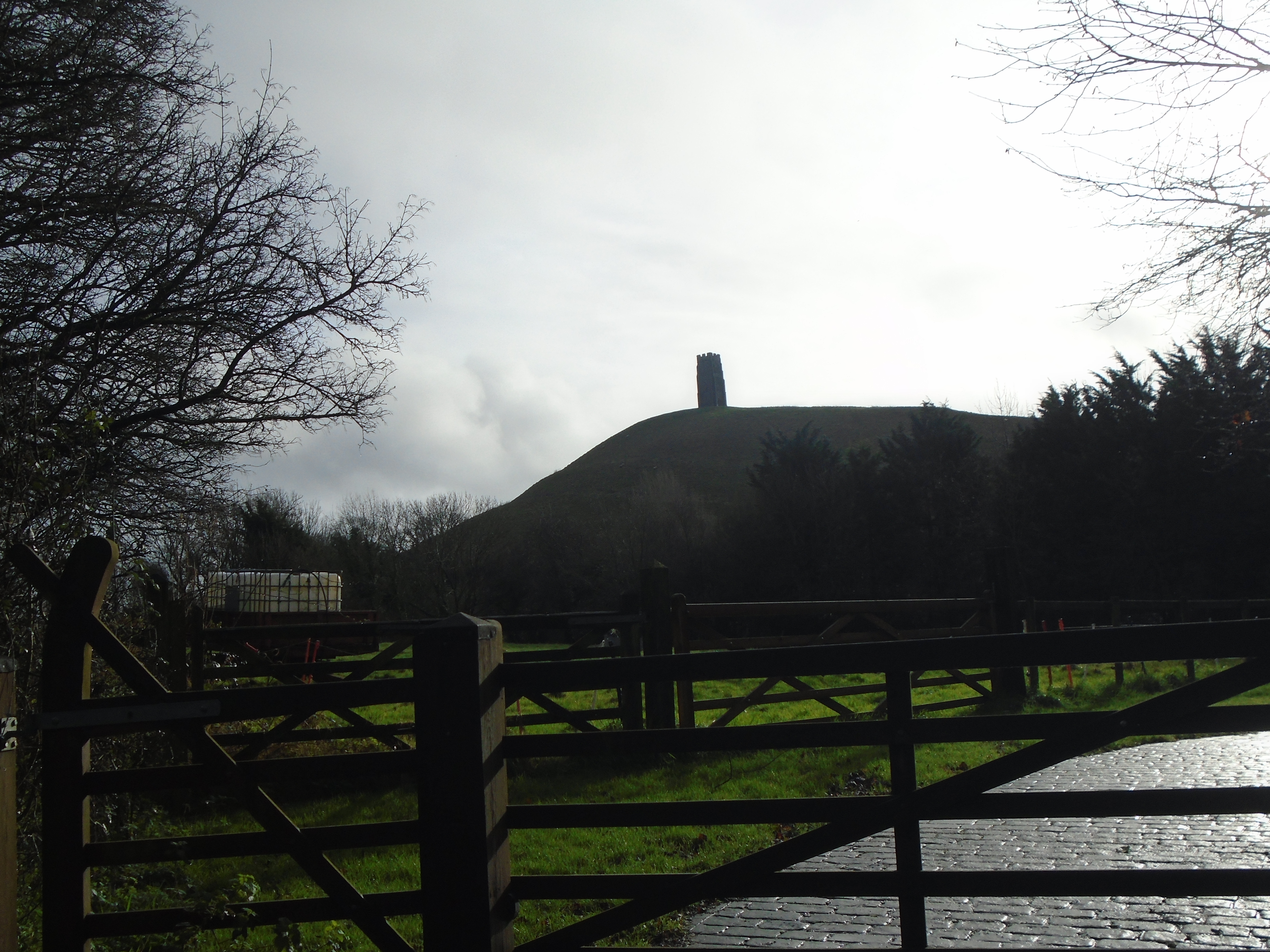
Time was moving on; it would be dark in two hours, and I wanted to climb the Tor. I began the ascent just around the corner from the Chalice Well, before you get to the White Spring. There were dozens of pregnant sheep grazing on the hillside, which reminded me that it will soon be lambing time, always a great time of year. I always think it is quite a biblical pastoral scene which reminds me of that great visionary William Blake. I stopped every few yards to observe the view over the Somerset countryside. 

Even late on a February afternoon there were quite a few other people going up or down the ancient pathway. Finally, I reached St Michael’s Tower at the summit. Surveying the Somerset levels below you could see a mist arising in the distance. The Tor can be seen from miles around above this mist. It is a phenomenon known as Fata Morgana which takes its name from Morgana Le Fey a sorceress in Arthurian legend. The tower is roofless, so sitting on a bench inside and looking up you get a free artwork of nature, namely the heavens above. As I gazed upwards I thought I saw a tiny angel descend, but sadly it was only a pigeon coming home to roost. 😊

After half an hour or so of mindful contemplation I thought I better be heading back down to the town below. I had some food at the Market Tavern and called in at The George & Pilgrim for a glass of wine as other pilgrims have done for hundreds of years. Back at the B & B I thought I’d have an hour’s nap before the evening, but when I woke up, I couldn’t be bothered going out again, especially as it had begun to rain. I slept soundly until 6.00 the next morning, little realising what a great day lay ahead. (To be Continued) 

The George & Pilgrim.


Sunday, February 04, 2024

Girl With A Typewriter.


It is possible that you are unfamiliar with the name Robert Doisneau, but I am quite sure that you have seen his work. Robert Doisneau (14 April 1912 – 1 April 1994) was a French photographer. From the 1930s onwards he roamed the streets of Paris looking for interesting subjects to photograph. He once said, ‘The marvels of daily life are so exciting; no movie director can arrange the unexpected that you find in the street’. 

The photograph that I am certain you will know is his 1950 image Le baiser de l'hôtel de Ville (The Kiss by the City Hall), a photograph of a couple kissing on a busy Parisian street. This iconic picture for millions of people has come to represent the nostalgia and romance of Paris in the post-war years. It was the first of his works that I became aware of. Very often when I am listening to the Van Morrison song Angelou that image will come into my mind, ‘In the month of May, In the city of Paris, In the month of May, In the city of Paris, And I heard the bells ringing’. However, there is another photo by Robert Doisneau that I find just as romantic and intriguing. 

One day in the summer of 1948 he was working on an assignment for Paris Match magazine when he spotted a young woman sitting by the Seine at the Ile de la Cite working on a manual typewriter and he took her picture. For me that photo is synonymous with the creative spirit of Paris in the pre and post war years. There were many great French writers living in Paris such as Albert Camus, Jean-Paul Sartre, and Simone de Beauvoir, but Paris in that era had also become a mecca for many of my favourite authors such as Henry Miller,( His book Quiet Days In Clichy gave me the title of this blog page) Ernest Hemingway, Oscar Wilde lived out his last years in poverty in Paris, George Orwell wrote Down and Out In London and Paris here, James Joyce wrote Ulysses which was published in Paris by Sylvia Beach at her famous Shakespeare & Company bookshop. James Baldwin also lived here. All these people were drawn to Paris by the creative freedom and artistic Bohemian atmosphere. That is why the photo of the girl with the typewriter fascinated me. I wanted to know who she was, and also what was she writing? Years ago it might have been difficult to find this out, but now thanks to the likes of google and Wikipedia it was quite an easy task.

It turns out that she was English, and her name was Emma Smith. She was 25 years old at the time of the photograph and was living in Paris while working on her second novel. She was born in Cornwall in 1923. During the Second World War, she worked on the canals as a boatswoman. Her experiences working on the Grand Union Canal would become the basis for her debut novel, Maidens' Trip. In 1946, still only 23, she went to India with a team of documentary filmmakers where she became friends with Laurie Lee and encouraged him to complete his memoir of his childhood in Gloucestershire Cider With Rosie which eventually sold millions of copies. Emma returned to England in 1947 and wrote her first book. Maidens' Trip which a commercial success and won the John Llewellyn Rhys Prize. With the proceeds from it, she moved to Paris, where she took a room in the Hotel de Tournon, and drawing on her memories of India, typed up her second novel The Far Cry. That was what she was working on when Robert Doisneau came across her on that fateful day. The book was published to great acclaim in 1949. 


She married in 1951 and had two children, but sadly her husband died after only six years of marriage. She moved to rural Wales with her children and seemed to have lost interest in writing for many years. Eventually she produced four books for children and a novel which didn’t repeat the success of her earlier books. In recent years there has been a revival of interest in her work. The novelist Susan Hill found a copy of The Far Cry in a jumble sale and wrote an article full of praise for it in the Daily Telegraph. The book was finally reprinted as a forgotten classic by Persephone Books of Bath 53 years after its first publication. Emma lived in Putney, London from 1980. In her 80s she published two memoirs The Great Western Beach and As Green As Grass which were both received enthusiastically by critics and public alike. She died peacefully in April 2018 aged 94. For many people she will be remembered for her books, but I think for me she is immortalised in that famous photograph of Robert Doisneau taken on a summers day 76 years ago which symbolises the creative atmosphere and romance of Paris when the world seemed a lot more optimistic than it does now.

Robert Doisneau.


Popular Posts