Thursday, December 16, 2021

Small Things Like These by Claire Keegan.

Apart from a brief trip to the post-office I haven’t left the house since Monday. I have been quite content staying in with my music and books. I am still trying to finish reading Nausea but was pleased to put Jean Paul Sartre aside for a few hours yesterday when a book arrived in the post from a friend in Ireland. It is called Small Things Like These by Claire Keegan. I hadn’t heard of Claire before, but I am very grateful to my friend because I absolutely loved this book. I’ll just tell you a little about the author. She was born in County Wicklow in 1968, the youngest in a large catholic family and was brought up on a farm. She published Antarctica her first collection of short stories in 1999 to great acclaim. Her previous book Foster won many awards and is on the curriculum of the school leaving certificate in Ireland. Small Things Like These is her most recent book, published earlier this year. I would describe it as a novella because you can read it in a few short hours, as I did yesterday. Published by Faber it is a very attractive book even to hold in your hand. The dust jacket design is from a painting by Peter Breugel the Elder called Hunters In The Snow. It is a desolate scene of an unsuccessful hunt and crows can be seen on the branches of bare trees. Crows also figure prominently in the pages of this book, and I see them as an ill omen. It is a very apt and clever design because it sets the scene and the mood of the book even before you have started to read.

The timing of this book arriving is perfect because it is set in the town of New Ross in the days leading up to Christmas 1985. The protagonist in the story is a coal & timber merchant called Bill Furlong. He was born to an unmarried mother who died when he was twelve. He was brought up by his mother’s kindly employer, a lady called Mrs Wilson. He worked hard to build up his business, got married and has five daughters. Although on the surface he has a happy marriage and feels quite lucky and content, he often wonders who his father is. He treats his workers well and shows kindness to those less fortunate, but his wife seems to think he is too soft and should just look after his immediate family because the economy was going through a tough time in 80s Ireland. One day while out delivering coal he makes a discovery that leads him to a moral dilemma. 
I won’t tell you anymore about the story because I hope you will read it for yourself. Some of the story makes quite grim reading, but I found the conclusion very spiritually uplifting. It is about having the courage to do what is right, rather than worry about what others may think. We know from history that evil thrives when people look the other way. I loved reading this book because of Claire Keegan’s style of writing. It is very simple. A lesser writer might have made the story three times as long. With Claire Keegan every sentence is to the point, concise and carefully constructed. Even so, the characters and landscape are portrayed beautifully. You feel that you know this place and people. I wonder if the youngest daughter Loretta was based on Claire Keegan herself because she seems to know her very well. 

There is a lot of symbolism in the story, apart from the crows. and just one sentence can contain a whole lot of meaning. In one scene Bill gets lost and sees an old man with a scythe cutting thistles and asks him where the road leads to, “This road will take you to wherever you want to go, son”. 
I learned a couple of Irish words reading the book. I think leanbh means baby and puckaun is a goat. Also, Bill’s friend Ned sings a song called The Croppy Boy. I looked that up as well and found the song came from the rebellion of 1798 and a croppy means a rebel. I wanted to hear the song and found a beautiful live version from 1965 by a singer I didn’t know called Anne Byrne who sounds to me like an Irish Joan Baez. I have shared it below if you would like to hear it. I can’t think of anything else to say now apart from that I highly recommend this book and I look forward to reading more stories by Claire Keegan.


The Croppy Boy - Anne Byrne

Tuesday, December 07, 2021

Review: Flying Into Mystery by Christy Moore.


It was a dark and dirty morning and my day had just begun.
Storm Barra was battering Britain, so I knew I wouldn’t be venturing out today. There was a knock on the door. It was a soggy postman with a package for me. I knew what it was, a new CD by Christy Moore called Flying Into Mystery. Great! that was my day sorted out. I made myself a cup of tea and sat down to give the music my full attention. It is two years since the wonderful live Magic Nights album, and five years since Lily his last studio album was released. I must say that at the age of 76 Christy’s voice sounds as good or better than ever. He is ably assisted on this new album by Jim Higgins on percussion and organ, Seamie O’Dowd on guitar, harmonica, bouzouki, mandolin, fiddle, banjo, bass, and vocals, Gavin Murphy on keyboards and orchestral arrangements, Mark Redmond on uilleann pipes, James Blennerhassett on double bass and Christy’s son Andy Moore on backing vocals.


The opening song Johnny Boy was written by the late great guitar player Gary Moore. The song originally featured on Gary’s 1987 album, Wild Frontier, and was a tribute to his friend and former Thin Lizzy bandmate, Phil Lynott. (The name Johnny cropped up in a lot of Phil Lynott's songs, and also album titles) I have written previously about when I saw Gary when he was only 18 and in the band Skid Row. I still think to this day that Gary was one of the greatest guitar players of all time. He wasn’t the greatest of singers though in my opinion, which is why I prefer Christy’s version of this great song. It tears you up emotionally, especially if it reminds you of a lost friend or loved one. As well as the voice, the harmonica and soulful pipes are played exquisitely. (Listen to Johnny Boy below) Clock Winds Down is a very topical reminder of the climate catastrophe which is already happening to the planet. It is written by Jim Page, who wrote Hiroshima Nagasaki Russian Roulette, which Christy recorded with Moving Hearts. I wonder if Greta Thunberg has heard this song. I think she would approve.


 On Christy’s previous studio album Lily one of my favourite songs was The Gardener written by Paul Doran and on this album another song by Paul is included called Greenland. You can notice the similar poetic style in the lyrics, which are obviously written by someone who is close to nature. Christy’s son Andy also sings on this track. Flying Into Mystery has been previously recorded as 16 Fishermen Raving. When I read the lyrics on Christy’s website https://www.christymoore.com/wp-content/uploads/2021/11/Lyrics-and-Sleevenotes-Flying-Into-Mystery.pdf I couldn’t understand the significance of fishermen carrying a caul, so I googled it and found that in folklore people believed  that possession of a baby's caul would bring its bearer good luck and protect that person from death by drowning. Cauls were therefore highly prized by sailors and fishermen because a caul was regarded as a valuable talisman. The next song is Gasun which is another word I didn’t understand until recently. I think it means young boy or lad. Probably similar to the French word garcon meaning boy. It is a sad song by Tom Tuohy and Ciaran Connaughton about homelessness. All I Remember is another song that Christy has recorded before. It is written by Mick Hanly and although the words are humorous there is a dark undercurrent from the days when priests and nuns called the shots. I can relate to all that because although brought up in England I went to a catholic primary school where we were taught by nuns, the Sisters of Charity. Some of them were awful, but I tell you they weren’t all bad. There was one called Sister Theresa who always gave me a present on St Patricks Day.


December 1942
is lyrically one of the most harrowing songs I have ever heard. It is a graphic description of a train full of Jewish people arriving at a concentration camp. Christy has dedicated it to Tomi Reichental and in the sleeve notes it says that Tomi has written a book called I Was A Boy In Belsen. I might read that book soon. The song is written by Ricky Lynch from Cork. Although it is difficult to listen to this song, I think it is important to be reminded of the fragility of so-called ‘civilisation’ and how easy it is to descend into chaos and hatred. You only have to look at the news to see how fascism is again rearing its ugly head around the world. Van Diemen’s Land is a traditional song which Christy learned from Mike Waterson in Hull in 1968. As you know, if you read my stories on here regularly that I am a big fan of The Watersons. 


Bord Na Mona Man
is another song which got me googling. I found out that Bord Na Mona is a semi-state company in Ireland, created in 1946 by the Turf Development Act 1946. The development of peatlands involved the mechanised harvesting of peat, which took place primarily in the Midlands of Ireland. The song shows the great sense of humour that Christy is blessed with. I love the banjo playing by Seamie as well. 

Zozimus

Myra’s Caboose
also has some funny lyrics. Christy heard it played by Willie Clancy in 1964 as The Gander and Christy has put his own re-arrangement to it, set it in an old railway carriage and changed the title. Zozimus & Zimmerman is an interesting song. Wikipedia tells us that Michael J Moran (c. 1794 – 3 April 1846), popularly known as Zozimus, was an Irish street rhymer. He was a resident of Dublin and known as the "Blind Bard of the Liberties" and the "Last of the Gleemen". Zimmerman as you know is none other than Bob Dylan. The two come together in this very clever song by Christy and Wally Page. There is almost a complete setlist of Dylan songs in the lyrics. The album closes with a fabulous rendition of Dylan’s I Pity The Poor Immigrant. This song has also taken on new meaning recently when you look at the plight of refugees around the world.
 I have mainly mentioned the lyrics in this review, but I must say that the arrangements on this and other songs by Gavin Murphy are wonderful and all the musicians deserve praise. This album is a fine addition to the great body of work by the one and only Christy Moore.

Friday, December 03, 2021

Chaise Longue by Baxter Dury.

Baxter & Ian Dury.
It is Friday evening, and I am listening to a CD called Ten More Turnips From The Tip. It is the last studio album by Ian Dury And The Blockheads released in 2002, two years after Ian’s death. It is a very enjoyable and underrated album with some great tracks such as It Ain’t Cool, Dance Little Rude Boy Dance, Cowboys, & One Love. I hadn’t played it for years until I was reminded of it yesterday. I remember vividly the night I bought the album. It was when The Blockheads played at The Cheese & Grain in Frome about fifteen years ago. When I got home that night and went to play the album I was disappointed to find that there was no CD inside the case. Next day I tracked down the bands phone number and rang up to complain. To my surprise it was Micky Gallagher the keyboards player who answered the phone. He passed me on to a nice lady who was on their management team. It turned out that I had accidentally been given a display item. I ended up having a great chat with her about Ian and the band. I told her how I had always felt a connection to Ian because he taught my brother at Canterbury Art College which is where Ian formed his first band Kilburn & The High Roads with some of the students. A few days later a correct complete CD arrived in the post.

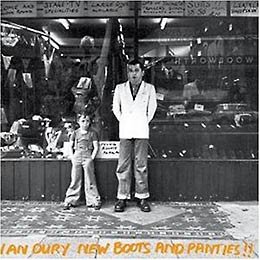
The reason I was reminded of this album is because I have just finished reading a book called Chaise Longue by Baxter Dury. Baxter is Ian Dury’s son who was born in 1971. I found the book so enthralling and moving I read it all in one day. If you know the album New Boots & Panties which is one of my favourite records of all time, you will have seen the famous photo of Ian and Baxter on the cover. Baxter was only about six years old when that album was released. His book Chaise Longue is a memoir of his turbulent childhood. His elder sister was called Jemima and his mother was Betty. Ian and Betty separated and were finally divorced in 1985. Baxter later had two half-brothers, Bill and Albert when Ian met sculptor Sophy Tilson. Because of coming from a broken home Baxter’s early years were divided between spells of living with Betty or Ian. The book chronicles this chaotic period in his life. It is funny and sad in equal measure. Just to write it is a remarkable achievement because Baxter doesn’t appear to have had a proper education at all. He was always playing truant, refusing to go to school, or getting expelled. It is a wonder that he can read or write at all. 

Ian was often absent, away on tour, or filming and Baxter would be left in the care of some strange characters such as Pete Rush who was a six-foot seven roadie and drug dealer who was known as the Sulphate Strangler because of his habit of picking people up by their neck. That is what reminded me to play the album again, because there is a track on it called Ballad Of The Sulphate Strangler. There are other amazing characters in the book such as Alfie Rowe known as Spider, and Kosmo Vinyl. I remember Kosmo because one night when we saw Ian Dury & The Blockheads at Bristol Hippodrome the band shone a spotlight on the audience and picked out a girl for a spot prize. She went onstage all excited, and Kosmo presented her with a packet of Scotch eggs. The book is called Chaise Longue because living in this chaotic environment with a motley crew of strange people coming and going there often wasn’t a bedroom for Baxter to sleep in, so he often slept on an old Edwardian daybed in the living room which Ian called the chaise longue.

Ten More Turnips.
It was a difficult upbringing for Baxter, but Ian and Betty must have done something right because Baxter has become a very successful musician in his own right and has made about six highly acclaimed albums of his own and is now a writer. Reading the book hasn’t changed my view of Ian Dury. He had a very hard life. He contracted polio at the age of seven which left him paralysed on one side. That would have broken a lot of people, but Ian achieved great things in art and music and acting. He was a national treasure. Nobody since has equaled Ian Dury for writing such witty, poignant and funny lyrics as in his songs. As well as Jazz, Soul & Funk, Ian loved English Music Hall which is where the humour in his lyrics came from. Songs such as Sex & Drugs & Rock N Roll, Hit Me With Your Rhythm Stick, Reasons To Be Cheerful, There Ain’t Arf Been Some Clever Bastards & What A Waste are classics of British music. Ian had to be hard in order to succeed. It was a tough world for a raspberry ripple (Cockney rhyming slang for cripple) He resorted to psychological bullying of people in order to get his way and achieve his dreams. I always knew that Ian had a dark side, so nothing in Baxter’s book surprised me. Underneath all this, Ian had a heart of gold which is shown by all his charity work. I was especially pleased when his song Spasticus Artisticus was chosen as the theme song for the London Para-Olympics in 2012.

Ian & The Blockheads.


The sulphate strangler died of a heart attack while in police custody. When I read that in the book, I felt sorry for him. I think, like Ian he was another person who probably meant well, but didn’t know how to go about expressing it. Baxter knows the truth, not me. In a way the story of his mother
Betty is even more tragic than Ian’s. She was involved in a car crash in which a motor cyclist died, and Betty never recovered from the trauma and guilt. She died aged only 52. There are many reasons to be tearful in this book. Despite that, as I said, I really enjoyed reading Chaise Longue by Baxter Dury. I don’t have any of Baxter’s albums in my collection, but I think I will buy one in the very near future and tell you all about it here. Cheers.

Baxter & Ian.

Tuesday, November 23, 2021

Fred Neil, Bleecker & Macdougal.

It was Bob Dylan who ignited my interest in the 1960s scene in Greenwich Village. Jack Kerouac added to it of course. Jack was once asked what it felt like to be famous and he said, “It feels like old newspapers blowing down Bleecker Street”. All this sort of thing added to my romantic view of the area. I think that is partly why I enjoyed the film Inside Llewyn Davis so much. In the past I have bought albums by and written about many artists associated with this time and place, such as Karen Dalton. Tim Hardin, Dave Van Ronk, Tim Buckley and Phil Ochs. I think it was after I wrote my review of Phil Ochs several months ago that a facebook friend suggested that I also check out Fred Neil. Finally, I did and looked on the internet to see what CDs were available. I opted for a CD on the Electra label which contained Fred’s first two albums Tear Down The Walls & Bleecker And Macdougal,

I must admit I was initially a bit disappointed with Tear Down The Walls. I didn’t think it was any great shakes. Released in 1964 it isn’t a solo album, but by a duo comprising of Fred and Vince Martin. I think Vince Martin was a much lesser talent. I was interested to see that John Sebastian plays mouth harp on the album. He later became world famous as a solo artist and member of Lovin’ Spoonful. Also, Felix Pappalardi plays bass and I remember him as a member of rock band Mountain in the 1970s. After two listens I did not think any of the tracks particularly grabbed my attention. Fred Neil wrote six of them. If I had to choose, I would say that the title track is possibly the best. It is the kind of protest song that Peter, Paul & Mary, Tom Paxton or Pete Seeger were singing at the time. There are some cover versions here, but I don’t think they are that great. Their version of Morning Dew isn’t a patch on Bonnie Dobson’s original, and I have heard better versions of Lonesome Road, most recently by Bill Callahan. To my ears the best thing about the album is Fred Neil’s distinctive voice and the excellent bluesy guitar and harmonica playing.

The second album Bleecker & Macdougal is a different kettle of fish altogether, a vast improvement. It is Fred’s first solo album released in 1965. As well as Sebastian & Pappalardi, there is also electric guitar on this album which was sacrilege to many of the folk purists of the time, so this album could be considered as one of the forerunners of Folk-Rock. The title song opens the album in fine lively rock influenced style. A lot of the songs are steeped in blues, such as Blues On The Ceiling, Sweet Mama, Yonder Comes The Blues and Gone Again. I think Candy Man became a minor hit for Roy Orbison. Mississippi Train is very rock influenced with electric guitar to the fore. The harmonica intro reminded me of The Beatles, I Should Have Known Better.

The outstanding tracks for me are A Little Bit Of Rain with very emotional singing accompanied by subtle guitar strumming, The Other Side Of This Life which is very melodic with superb vocal delivery. The Water Is Wide which is a traditional song with the same roots as Carrickfergus which all Van Morrison fans will know. I think Handful Of Gimme could show Fred Neil’s growing dislike for the music business. Maybe Fred shared Jack Kerouac’s windblown view of the fame game. Although I am pleased that I bought this CD, I have a nagging underlying feeling that I haven’t heard the best of Fred Neil. Maybe I should have bought his 1967 album which contains The Dolphins which I know from Beth Orton’s and Tim Buckley's cover versions. (I just found a video of The Dolphins on youtube which I have shared below. It is the only know footage of Fred performing on stage) That album also has his version of Shake Sugaree by Elizabeth Cotten which I wrote so glowingly about recently. It also contains Fred’s own song Everybody’s Talkin’ which Nilsson covered and was chosen for the soundtrack of the film Midnight Cowboy ahead of Dylan’s Lay Lady Lay. 

I bet Fred was pleased about the success of that song, because it must have been the royalties from that hit which allowed him to step back from the music industry, live in Florida permanently and pursue his real love which was dolphin conservation. He co-founded the Dolphin Research Project in 1970, an organization dedicated to stopping the capture, trafficking and exploitation of dolphins worldwide. He progressively disappeared from the recording studio and live performance and sadly died in 2001. He had been suffering from skin cancer. He has left a small but great legacy and influenced many people, so I am pleased that I discovered the work of Fred Neil.

Bob Dylan, Karen Dalton, Fred Neil. Cafe Wha? Greenwich Village, 1960s.


Popular Posts